
By Renna Hickey, Sierra Nevada Regional Organizer for California Environmental Voters
On June 9, 2026, Nevada County did something no other California county has done: it wrote the dangers of abandoned gold mines directly into its long-term safety plan.
After a 5-0 vote by the Nevada County Board of Supervisors, this proactive policy change will have a big payoff for the people who live in the county—and it creates a model for other Gold Country counties to follow.
What are legacy mine hazards?
Legacy mines are giant holes and pits left behind after California’s Gold Rush ended about 100 years ago. California has an estimated 47,000 of them, many in the Sierra Nevada foothills, ground zero for the 1849 Gold Rush. Nevada County, an epicenter of California’s Gold Rush, has more than 10,000 mines on record, more than 8,000 of which are abandoned—left open after miners walked away. ¹ ²

The exposed cliffs of Malakoff Diggins, the largest hydraulic mining site in California, show the lasting scars of Gold Rush–era mining in Nevada County. Photo by Renna Hickey.
These abandoned mine sites carry dangers that persist today:
- Physical hazards: Open shafts and tunnels can collapse without warning, creating sinkholes that pose a serious threat to human life. In Nevada County, buildings built over abandoned mines have been damaged by ground that gave way underneath them, including one tragedy where a homeowner was killed by a mining tunnel that collapsed beneath his home. ³
- Chemical hazards: During the California Gold Rush, gold miners used extraction techniques that relied on massive amounts of mercury; An estimated 26 million pounds of mercury was left behind.⁴ Mining also released arsenic, lead, and asbestos into our soil and water. These toxins from the Gold Rush continue to contaminate California waterways more than 150 years later.
Why does the environmental impact of the California Gold Rush still matter in 2026?
The 1849 California Gold Rush brought large-scale environmental injustice to California, combining ecological devastation with the displacement, exploitation, and genocide of Indigenous communities.⁵ ⁶ In 1849, California had no environmental laws—or any laws—requiring anyone to clean up the mess these miners made. This era left behind a lasting toxic legacy threatening community and ecosystem health, and directly impacting our water, our air and our lives today.
Many abandoned mines in and around cities were stripped for metal, knocked down, bulldozed, and turned into schools, hospitals, and subdivisions. Others were left to collapse in the meadow, forest, or desert where they remain mostly invisible and dangerous. The result is that communities in “Gold Country” areas like Nevada County, Plumas County, El Dorado County, Inyo County, and Placer County are living on and around contaminated ground and physical hazards, often without knowing it.
This becomes even more urgent as the price of metals such as gold, silver, and copper continue to skyrocket, putting pressure on local governments to permit mines with “known” reserves—such as those in and around legacy abandoned mines.
What did Nevada County do to protect against legacy mine hazards?
On Tuesday June 9, with a vote of 5-0, the Nevada County Board of Supervisors updated the Safety Element of its General Plan—the chapter that guides how the county prepares for hazards like wildfire, flooding, and earthquakes—to add a dedicated section on mining hazards.⁷ ⁸
For the first time in California history, this new policy:
- Requires a Phase I Environmental Site Assessment for new development proposed above legacy mine activity. This standard first-step investigation flags potential contamination and physical risks before a new development project starts to keep communities safe.
- If any evidence of mining on or near the property is discovered in the Phase I evaluation, it requires a Phase II Environmental Site Assessment, including testing the site.
- Puts the county in a supporting role for agency referrals on cleanup and remediation.
- Requires physical and chemical hazard mitigation.
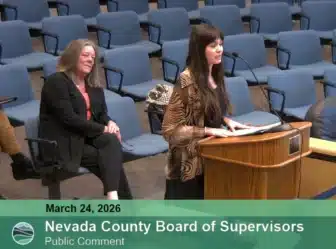
Renna Hickey, EnviroVoters’ Regional Organizer for the Sierra Nevada, gives public comment before the Nevada County Board of Supervisors. Photo: Nevada County Board of Supervisors.
These new policies proactively address risk before a tragedy strikes. This is a huge step in mitigating active hazards and toxins from the California Gold Rush that have long been ignored.
This is the first major victory of our Sierra Nevada Organizing program’s “Gold Isn’t Green” Campaign, developed by Community Governance Partnership’s (CGP) Sierra Protection Action Network, and California Environmental Voters while advised by Izzy Martin (formerly of The Sierra Fund).
This Nevada County General Plan Safety Element update comes after months of meetings between Gold Isn’t Green partners and Nevada County staff to push this groundbreaking policy forward. This is a huge step forward in Gold Isn’t Green’s goal to accelerate cleanup of toxic mine impacts, protect public health and safety, and empower communities to demand climate justice.
Why Nevada County’s General Plan can be a model for the rest of California
Proactive clean-up of abandoned mines is almost never pursued or even required. Abandoned mines, most of which are located on public lands, are “no one’s problem” despite having many agencies and jurisdictions that should be addressing them.⁹ Nevada County’s move shows there’s a practical solution for local governments that’s already on hand: using the General Plan, a document required for every California county, to require that legacy mine hazards get assessed before any new development–whether it’s a mall, medical building, or a mine—can begin. And it can require those projects to clean up the existing mining hazard as part of their permit to develop as a long-term solution to the issue of abandoned mining hazards.
Nevada County is ground zero for the 1800s California Gold Rush, but it’s not the only community impacted by mining in California. With Nevada County leading the way, other counties have a road map to follow so they can address the toxic legacy of the Gold Rush in their own communities while collaborating with our coalition on the unique needs of their county.
The work isn’t finished: Next steps for California
This win with the revisions to the Nevada County Safety Element addresses the risks of building over existing mines, but it doesn’t yet address the impacts new mines could create. In order to protect communities, we need to find ways to prevent the impacts that new mines have too.¹⁰
The effort to update Nevada County’s Safety Element began when the Community Governance Partnership (CGP) developed the Sierra Protection Action Network (SPAN). Through SPAN, CGP, California Environmental Voters and Izzy Martin (formerly of The Sierra Fund), developed the Gold Isn’t Green Campaign.
Gold Isn’t Green is a public education and organizing initiative created to help communities better understand the environmental, economic, cultural, and public health impacts of modern hard rock mining projects now being proposed across the Sierra Nevada. The campaign provides fact-based educational resources, convenes local leaders and community members, supports coalition-building across county lines, and helps residents engage effectively in public decision-making processes related to mining and public lands management. As new mining proposals emerge throughout the region, Gold Isn’t Green demonstrates how SPAN’s leadership development and organizing model can translate civic engagement into informed, community-driven action that protects watersheds, wildlife habitat, recreation economies, tribal cultural resources, and the long-term health of Sierra communities.
More recently, the Community Governance Partnership-led Gold isn’t Green coalition has grown to include the Sierra Club Toiyabe Chapter, No Hot Creek Mine, the Center for Biological Diversity, Friends of the Inyo, Earthworks, Trout Unlimited, the Crowley Fish Foundation, with others continuing to join.
To learn more about the toxic legacy of the Gold Rush and efforts to clean it up, visit The Sierra Protection Action Network’s Gold Isn’t Green campaign.
Sources Cited
- U.S. Environmental Protection Agency, Region 9, “Nevada City” abandoned mine feature. https://19january2017snapshot.epa.gov/www3/region9/waste/features/nevada-city/index.html
- The Diggings, “Nevada County, California” mine records. https://thediggings.com/usa/california/nevada-ca057
- NBC News, report on Nevada County mine tunnel collapse. https://www.nbcnews.com/id/wbna12457889
- California State Assembly, Natural Resources Committee, background paper (March 24, 2014). https://antr.assembly.ca.gov/sites/antr.assembly.ca.gov/files/hearings/Background%20paper032414.pdf
- American Indian Magazine, “The California Gold Rush.” https://www.americanindianmagazine.org/story/California-gold-rush
- History.com, “California’s Little-Known Genocide.” https://www.history.com/articles/californias-little-known-genocide
- Nevada County, “2026 Safety Element draft” (May 29, 2026). https://www.nevadacountyca.gov/DocumentCenter/View/60634/2026-Safety-Element-draft-52926-PDF?bidId=
- Nevada County, News Flash: “County Updates Safety Plan to Address Mining Hazards, Wildfire Risk and More.” https://www.nevadacountyca.gov/m/newsflash/home/detail/8784
- California Legislative Analyst’s Office, “Abandoned Mines” (Aug. 4, 2020). https://lao.ca.gov/reports/2020/4258/abandoned-mines-080420.pdf
- California Environmental Voters, “Did You Know Gold Mining Is Still Happening in California?” https://envirovoters.org/did-you-know-gold-mining-is-still-happening-in-california/